What 'pigeon blood' means on a ruby report, lab by lab
GRS, Gübelin, SSEF, Lotus, GIA, Bellerophon, GUILD and others: how each lab defines pigeon blood ruby, which require no heat or fluorescence, and which accept Mozambique.
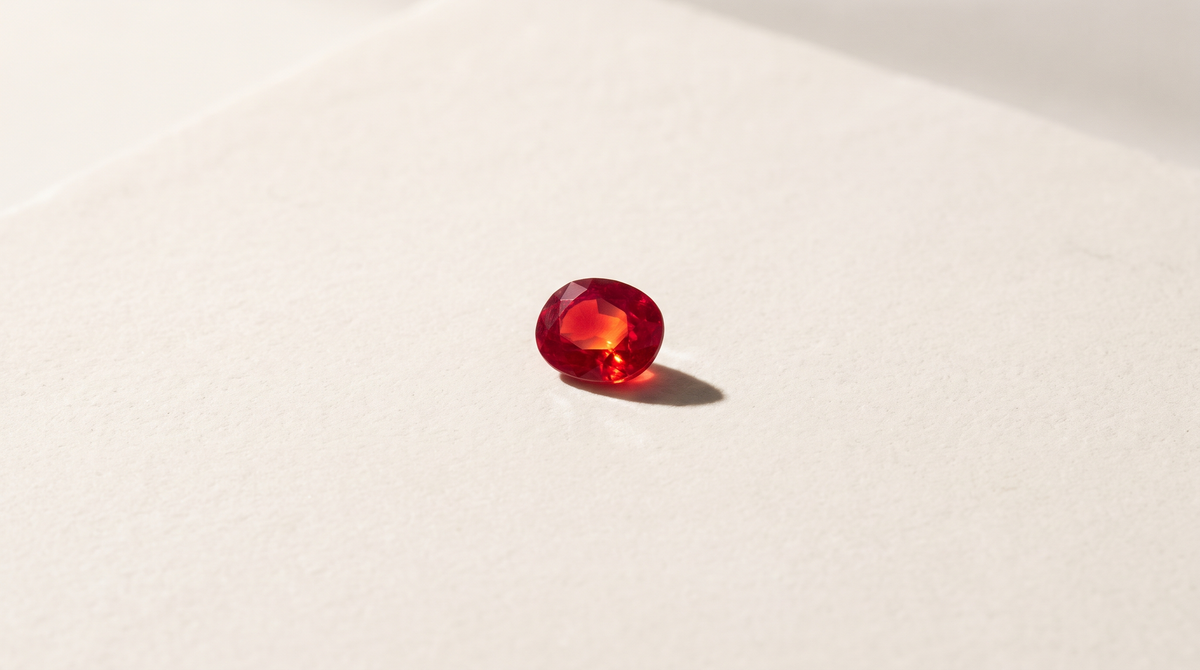
On a ruby report, "pigeon blood" or "pigeon's blood" is a trade colour term, not a quality grade. Each laboratory applies it to a narrow band of intense, saturated red, but the rules differ: Gübelin and SSEF exclude any treatment and require strong fluorescence, while GRS and Bellerophon Gemlab also accept traditionally heated stones. Always read the term together with the name of the lab that issued it.
What does "pigeon blood" mean on a ruby report?
The term began as a trade name for the finest Burmese rubies. Gübelin notes that there are no universally accepted definitions, and that laboratories add such terms because the trade asks for them. On a report it normally sits alongside a plain colour description, for example "vivid red", which describes the colour; the trade term then says the stone also meets that lab's extra conditions. Colour grading scales themselves are covered in our sister article on gemstone colour grading by laboratory.
GRS (GemResearch Swisslab)
- Colour: vivid red of high intensity and low tone, without brown or orange overtones, judged in daylight against master sets.
- Fluorescence: medium to strong under 365 nm UV; GRS notes Mozambican stones may glow somewhat less than Burmese ones.
- Treatment: heated and unheated rubies both qualify. Beryllium-treated, lead-glass-filled, surface-diffused and synthetic rubies are excluded, as are stones with H(c) or H(d) heating residues.
- Origin: applied independently of origin. GRS cites Burma, Mozambique, Vietnam, Tajikistan, Afghanistan and Madagascar, and states that about 20% of high-value vivid red Mozambican rubies it saw received the term.
- Size: no minimum stated.
- Wording: the designation appears on the front page of the report as GRS-type "pigeon's blood", alongside the colour grade.
Gübelin Gem Lab
- Colour: intense, saturated, evenly distributed red with no apparent modifier, though a minute purplish tint is acceptable. Ranges are fixed by masterstones.
- Fluorescence: strong fluorescence under UV is required, which Gübelin links to high chromium and low iron.
- Treatment: none. Heating or fissure filling disqualifies the stone.
- Clarity: relatively free of eye-visible or dark inclusions, with vivid internal reflections.
- Size: not a criterion.
- Wording: "Pigeon Blood Red". For untreated rubies of the same ideal colour but little or no short-wave fluorescence, Gübelin uses a separate term, "Crimson Red".
SSEF
SSEF applies the definition it harmonised with Gübelin: Gübelin dates the agreement to 2015, and National Jeweler reported the joint criteria in March 2016. They match the Gübelin list above: intense homogeneous red, strong UV fluorescence, no treatment of any kind, few visible inclusions and no size limit. The joint newsflash adds that most rubies from outside Burma contain enough iron to suppress fluorescence and so do not qualify. Gübelin's Daniel Nyfeler told National Jeweler that "only a very small percentage of rubies and sapphires qualify".
Lotus Gemology
- Colour: Lotus describes pigeon's blood as a glowing red likened to a red traffic light, and treats each colour type as a range rather than a single colour.
- Origin: not restricted. Lotus names Mong Hsu, Vietnam, Mozambique and Tanzania as well as Mogok.
- Related type: "Royal Red" is a shade darker, where iron reduces fluorescence; Lotus links it to sources such as Mozambique, Thailand and Cambodia.
- Treatment: Lotus issues no colour types for diffused stones. Its colour-types page sets no published rules on heating, fluorescence or minimum size.
AIGS
AIGS lists "Pigeon Blood" among the special colour names it uses for corundum and publishes reference charts, but its website gives no written criteria for colour, fluorescence, treatment or size that we could find.
GIA
GIA does use the term. Its September 2025 guide to coloured stone analysis says special terms such as "pigeon's blood" are reserved for stones meeting strict requirements, and only for natural stones that have not been diffusion-treated. Its third-quarter 2026 fee schedule lists a colour designation test covering pigeon's blood, padparadscha and royal blue, and a September 2026 Sotheby's guide describes a ruby whose GIA report carries the term in an appendix. GIA does not publish detailed criteria on these pages.
Bellerophon Gemlab
- Colour: red to very slightly purplish red, medium to medium-dark tone, intense to vivid saturation.
- Fluorescence: medium to strong under long-wave UV (365 nm), with rare faint exceptions.
- Treatment: none or traditional heating only. Diffusion of foreign elements, resin fracture sealing and lead or silicate glass filling disqualify the stone.
- Origin: Bellerophon names Burma (including Mogok and Mong Hsu) and Vietnam, and says low- to medium-iron rubies from Mozambique and Madagascar can meet the colour requirements.
- Size: no minimum stated.
GUILD Gem Laboratories
GUILD does not publish pigeon's blood criteria on its website. Its standard report page says only that stones meeting its top benchmarks may receive commercial names. Entries in GUILD's Aurora competition show how the wording appears: colour "Vivid Red", trade name "Pigeon's Blood", with strong fluorescence and "no indication of thermal enhancement" noted.
AGL and the LMHC
AGL describes colour with its own numerical rating and tone percentage, and the AGL pages we checked publish no pigeon's blood criteria. The Laboratory Manual Harmonisation Committee, which harmonises report wording among its member labs, has no harmonised pigeon's blood definition among the information sheets we reviewed.
Pigeon's blood is a club with different membership rules at every door.
How the labs compare
Unheated stones only
- Gübelin and SSEF: any treatment, including heating, disqualifies.
- GRS: heated and unheated accepted, with exclusions for advanced treatments and heavy residues.
- Bellerophon: no treatment or traditional heating.
- GIA: excludes diffusion; no other published heat rule. Lotus, AIGS and GUILD: no published heat rule.
Fluorescence required
- Gübelin and SSEF: strong fluorescence.
- GRS and Bellerophon: medium to strong at 365 nm.
- Lotus, GIA, AIGS and GUILD: no published requirement.
Non-Burmese origins accepted
- GRS: explicitly origin-independent, including Mozambique.
- Bellerophon: Mozambique, Madagascar and Vietnam can qualify.
- Lotus: Mong Hsu, Vietnam, Mozambique and Tanzania named.
- Gübelin and SSEF: no origin rule, but the fluorescence test excludes most iron-rich non-Burmese rubies in practice.
Minimum size is rarely set. Gübelin and SSEF state that size is not a criterion. Of the labs we checked, the Thai institute GIT was the one with a stated minimum, 0.20 ct for faceted stones.
Why the same ruby can pass at one lab and fail at another
Because the rules differ, a heated Mozambican ruby with medium fluorescence and the right colour could qualify as pigeon's blood at GRS, while Gübelin would describe its colour without the term. At the 2016 CIBJO Congress, one speaker described many reports being returned to labs, mostly in Asia, because each lab has its own standards, and GIA's Shane McClure said US clients regard colour designations mainly as a marketing device. Sotheby's puts it in balanced terms: the term can add desirability, but it does not set value on its own.
What to check before you bid
- Identify the lab, then read that lab's criteria rather than assuming a common standard.
- Check the treatment line. "Pigeon's blood" on a heated stone is possible at some labs and impossible at others.
- Look for the fluorescence note and the plain colour description beside the trade term.
- Verify the report itself; our guide on how to verify a gemstone lab report explains each lab's lookup.
- Compare photographs in daylight and indoor light.
Our Burmese rubies and Mozambique rubies are each listed with the issuing lab, report number and treatment status. Everything in the ruby collection is offered at a fixed price, and you can request a quotation or ask a question on WhatsApp from any product page.
This article discusses how laboratory terms can influence demand and price. It does not predict values. It is general information, not investment, tax or legal advice.
Frequently asked questions
Is pigeon blood a grade?
No. It is a trade colour term that each laboratory defines for itself. Gübelin states there are no universally accepted definitions, so the term only means what the issuing lab's criteria say.
Can a heated ruby be called pigeon's blood?
At some labs, yes. GRS accepts heated and unheated rubies, and Bellerophon Gemlab accepts traditional heating, while Gübelin and SSEF exclude any treatment.
Can a Mozambique ruby be pigeon's blood?
Yes, at labs that do not restrict origin. GRS, Bellerophon and Lotus all state that non-Burmese rubies can qualify, and GRS reports that about 20% of the high-value vivid red Mozambican rubies it saw received the term.
What is the difference between "vivid red" and "pigeon blood"?
"Vivid red" describes the colour itself. "Pigeon blood" is an additional trade term that tells you the stone also met that laboratory's extra conditions, such as fluorescence or treatment rules.
Does GIA use the term pigeon's blood?
Yes. GIA reserves the term for natural, non-diffused rubies that meet strict requirements, but it does not publish detailed criteria.