Colour versus carbon: why fine coloured gemstones and diamonds are moving apart in 2026
Diamond prices fell sharply in 2026 while the best rubies, sapphires and emeralds got harder to buy. What the latest figures show, and their limits.
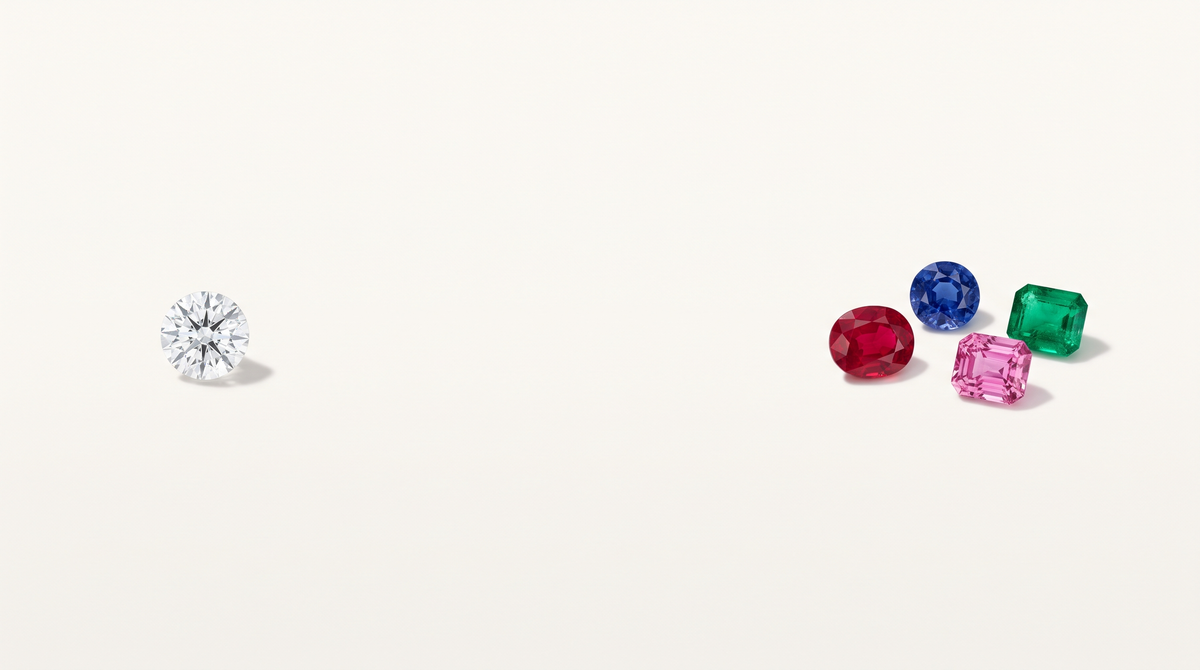
In 2026 the two halves of the gem trade are moving in opposite directions. Natural diamond prices are under heavy pressure, while the best coloured gemstones keep getting harder to buy. Here is what the latest figures show, and where the limits of those figures lie.
Diamonds: more supply, lower prices
Anglo American, De Beers' parent company, reported that the average rough diamond price index fell 16% in the first half of 2026. The consolidated average realised price was USD 105 per carat, 32% lower than a year earlier. Revenue from De Beers' three second-quarter sales events was USD 665 million, down 44% from USD 1.2 billion. Meanwhile production rose 88% year on year to 7.8 million carats in the quarter.
The company also named one of the causes directly: lab-grown diamonds continue to weigh on demand for lower-value natural diamonds. Lab-grown stones are physically and chemically diamond, which puts a ceiling on what buyers will pay for everyday natural goods.
Coloured gemstones: the constraint is geology
No factory can make a Mozambican ruby with a Mozambican origin report, and top material from key sources such as Montepuez, Myanmar and Colombia is in limited supply. Gemfields reported that the grade of premium ruby at its Montepuez mine halved between 2025 and mid-2026. Its October 2026 ruby auction averaged USD 564.54 per carat, more than double February's figure, on about half the volume. We look at that sale in detail in our ruby auction analysis.
Dealers report the same pattern at the top of the market. Speaking to the trade magazine GEMSWORLD 2026, Ashish Dangayach of Color Jewels said that prices for top Burmese rubies and sapphires and Colombian emeralds rose by high-single to low-double digits in 2025, driven by limited output from Myanmar and Colombia. GEMSWORLD also lists Mahenge spinel, Paraíba tourmaline, and pink and padparadscha sapphires among 2025's strongest performers.
Emeralds have recovered from oversupply rather than boomed. GUILD Gem Laboratories described Gemfields' September 2025 high-quality emerald sale (USD 32 million, average up from USD 113 to USD 160 per carat) as a return to pre-oversupply levels, not a new peak. Its commercial-quality auction that closed on 10 September 2026 sold all 44 lots for USD 29.6 million.
A diamond's price is increasingly set by what a factory can make. A fine coloured stone's price is set by what the earth gives up.
Read the trend carefully
- It applies to fine stones. The price strength sits in well-coloured, clean, documented stones. Commercial-quality material behaves very differently.
- There is no public price index for coloured stones. Unlike diamonds, every coloured gem is graded and priced individually, so the comparison above uses auction averages and dealer reports, not a single benchmark.
- Origin and treatment drive value. An unheated stone with a reputable origin report sits in a different market from a heated or untested one.
Buy a gemstone because you love its colour. If you also care about how it holds value, buy it with a laboratory report.
This article summarises public company reports and trade press. It is market information, not investment advice.