Ruby prices at Gemfields' October 2026 auction: what doubled, and what didn't
The average price per carat at Gemfields' October 2026 ruby auction more than doubled compared with February. Here is why, and what it means for anyone buying a fine ruby.
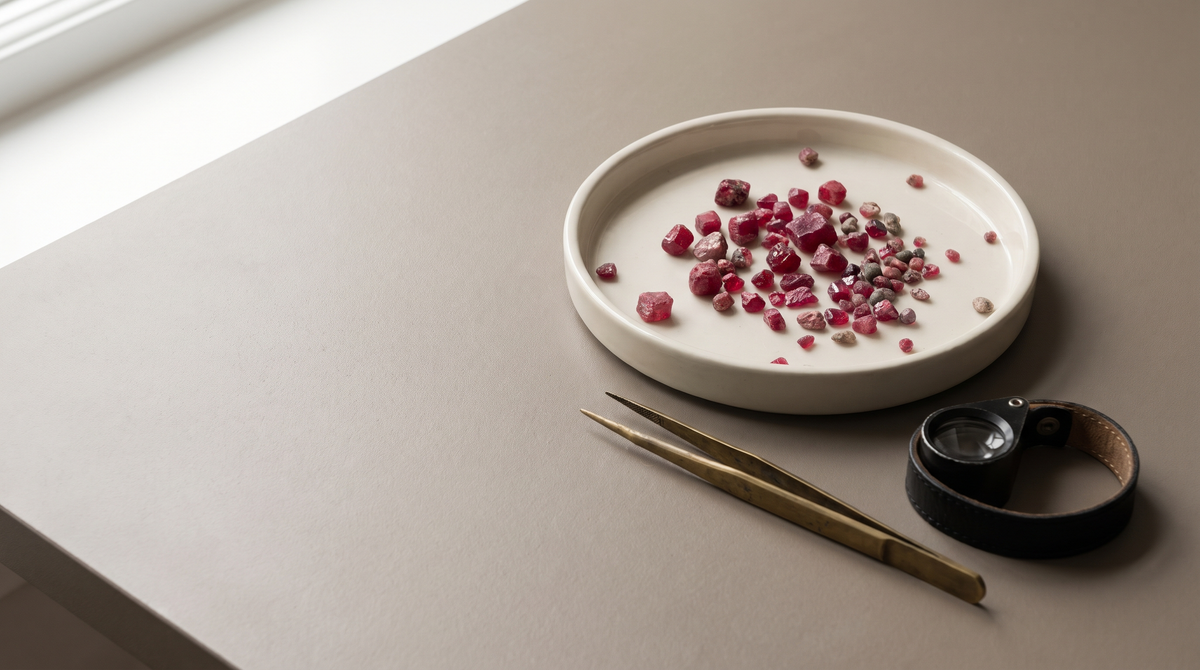
Gemfields' October 2026 ruby auction averaged more than twice the per-carat price of its February sale. The headline is accurate. What it means for anyone buying a fine ruby is more interesting, and it starts with a mine in northern Mozambique.
The numbers
Gemfields sells the rough rubies mined at Montepuez Ruby Mining (MRM) in Mozambique through competitive auctions. Its mixed-quality auction ran from 5 to 16 October 2026. The company reported USD 52.0 million in revenue, with 90 of 99 lots and 92,153 of 102,099 carats sold, at an average of USD 564.54 per carat.
Eight months earlier, the February 2026 mixed-quality auction (held in Bangkok and online, after being moved from December) raised a very similar USD 53 million. It sold more than twice the weight, though: 189,620 carats, at an average of USD 279.39 per carat.
Same money, half the rubies
Put the two sales side by side and the story is clear. Buyers spent roughly the same amount in both auctions, but in October they received about half the carats. The average price per carat therefore roughly doubled. Trade publication Jewellery World, which reported the 102% jump, adds a fair caveat: auction averages depend on the size and quality mix of what is offered, so this does not mean every ruby in the market doubled in price.
That caveat matters, because the quality mix is exactly what is changing at the mine.
Why supply is tightening
In its June 2026 update, Gemfields reported that ruby output at MRM was below expectations, mainly because of falling recovered grades. The grade of premium ruby dropped from 0.06 carats per tonne of ore in 2025 to 0.03 in the five months to 31 May 2026. The company added that premium rubies typically make up more than 70% of MRM's revenue but less than 5% of the weight it produces and sells. It also cited heavy rain, commissioning problems at its new processing plant, security incidents near the concession and illegal mining, and warned of a material adverse impact on auction inventory for at least the rest of 2026.
The same month, Gemfields tested a new format for lower grades. Its first "Trade Select" auction sold 348,409 carats for USD 23.1 million, an average of USD 66.30 per carat. The gap between that figure and October's average shows how far apart the top and bottom of the ruby market now sit.
Rough auctions lead the market. Cut, polished and certified stones follow more slowly, and only partly.
What it means if you are buying a ruby
- Fine goods are getting scarcer at source. Less premium rough from Mozambique, one of the world's main ruby suppliers, tends to support prices for well-coloured, clean stones.
- Rough prices are not retail prices. A rough auction average says nothing direct about the price of a specific cut stone. Cutting yield, colour, clarity, treatment and size decide that.
- Documentation matters more, not less. When supply is tight, a report from an independent laboratory that states origin and treatment is the clearest way to compare one stone with another.
Every stone in our ruby collection, including our Mozambique rubies, is sold individually with its independent laboratory report.
This article summarises public company announcements and press reports. It is market information, not investment advice.