Ceylon sapphire market 2026: shows, exports and what buyers should check
Sri Lanka's 2026 gem shows, export figures and reform promises, and why heating and origin reports still matter most to Ceylon sapphire buyers.
Sri Lanka spent 2026 courting buyers at home and abroad and promising to make its gem trade easier to do business with. The export numbers behind the Ceylon sapphire remain modest next to official ambitions, and for anyone buying a stone the practical questions are unchanged: has it been heated, and can its origin be shown?
A year built around trade shows
The calendar opened with Gem Sri Lanka 2026, held from 7 to 9 January at the Shangri-La in Colombo and organised by the Ceylon Gem and Jewellery Traders Association. A press release issued on 12 January by GUILD Gem Laboratories, the show's platinum sponsor for a third consecutive edition, put the exhibition at 150 booths and said Prime Minister Harini Amarasuriya attended the opening. The release also claimed record attendance and record sample submissions but gave no figures, so we do not treat those claims as established.
A Sri Lanka pavilion of 60 companies followed at the 73rd Bangkok Gems & Jewelry Fair (22 to 26 February), according to the foreign ministry. At home, Gem City Ratnapura ran from 31 August to 2 September. Deputy Minister of Industry Chathuranga Abeysinghe said at its close that turnout had beaten the previous year, Newswire reported on 3 September, though no visitor or sales figures were published. Next up are Gem Sri Lanka 2027, presented to buyers in Bangkok on 6 September, and the 34th FACETS exhibition, set for 4 to 6 January 2027 in Colombo.
Exports: a modest base and competing targets
Speaking on 20 July 2026, Mangala Wijesinghe, chairman of the Export Development Board, said gem and jewellery exports earned more than US$300 million in 2025 and nearly US$170 million in the first five months of 2026, about 8% above the same period a year earlier. His target is US$1 billion by 2030. Other official voices have used larger numbers: The Morning reported on 29 September that foreign minister Vijitha Herath had cited a National Gem and Jewellery Authority (NGJA) aim of US$3 billion in annual exports by 2030, and Abeysinghe, closing Gem City Ratnapura, put the sector's potential at around US$3 billion. Targets a factor of three apart are aspirations, not forecasts.
The trade's own complaints are more concrete. The Sunday Times reported on 19 July that the Sri Lanka Gem and Jewellery Association was lobbying for simpler procedures, with its president, Akram Cassim, objecting to an effective 30% tax burden on some activities. One bilateral figure stands out: the Daily FT reported on 15 September that Sri Lanka's exports to Thailand more than doubled in 2025 to over US$90 million, with precious and semi-precious stones making up almost 70%.
Policy: promises, not yet rules
At an industry conference in Colombo on 27 September, Sunil Handunnetti, minister of industry and entrepreneurship development, said the government would work to liberalise import and export frameworks for gems, cut unnecessary tax and procedural barriers, and set up an international gem hub in Colombo next year, according to The Morning. Abeysinghe has also spoken of improving traceability. In the sources we reviewed, none of this had yet become a published regulation, and no 2026 NGJA auction results were reported.
The more Sri Lanka succeeds as a trading and cutting hub, the less a Colombo invoice tells you about where a sapphire was mined.
What it means for Ceylon sapphire buyers
GUILD's own release notes that Sri Lanka's trade also draws rough from Africa, Madagascar and Southeast Asia, and the government wants to ease imports further. A stone bought or cut in Sri Lanka is therefore not automatically of Sri Lankan origin.
Origin is harder than the label suggests
GIA's research on blue sapphire origin (Gems & Gemology, Winter 2019) groups Sri Lanka with Madagascar and Myanmar as metamorphic sources whose trace-element data overlap heavily. Fine rutile silk is the main inclusion pointing to Sri Lanka, yet heating can dissolve it, which GIA says can make origin calls for heated stones very difficult or impossible. Gübelin Gem Lab makes a similar point about Sri Lankan and Malagasy sapphires: where the evidence is unclear, it writes, "the only professional conclusion is to leave its origin undetermined." An inconclusive result is honest science, not a laboratory failure.
Heated and unheated are different products
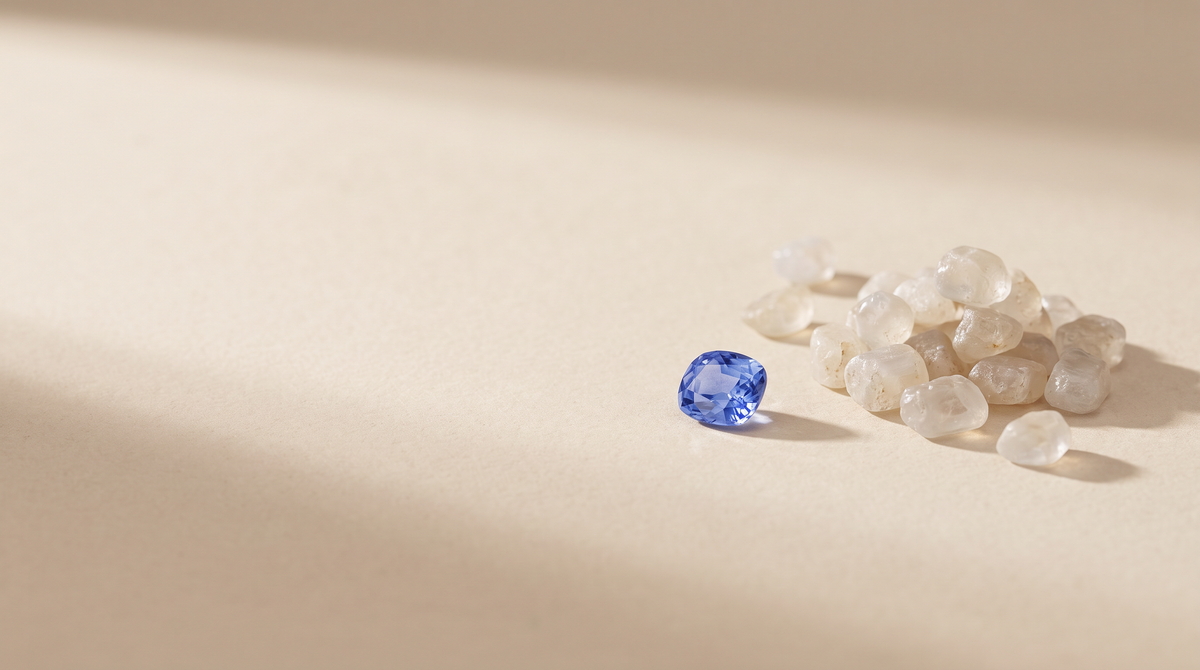
Geuda, a whitish, milky corundum found mainly in Sri Lanka, is heated to produce blue. A study presented at the International Gemmological Conference in 2023 heated geuda rough to 1,650°C and recorded a change from whitish to blue as fine particle inclusions dissolved. A report should state clearly whether there are indications of heating, and the price should reflect that statement.
A short checklist
- Ask for an independent report stating both treatment and origin, and read the comments.
- Accept that a heated stone may carry no origin opinion, or an inconclusive one.
- Do not pay a Ceylon premium on a seller's word alone.
Our certification and treatments page and our guide to GIA coloured gemstone reports explain what to look for on a report. You can also browse our blue sapphire collection and padparadscha sapphire collection.
This article summarises official statements and press reports on Sri Lanka's gem trade as of 27 October 2026. It is market information, not investment advice.