Spessartite garnet buying guide: Mandarin colour, origins and value
How to judge spessartite garnet: what Mandarin and Fanta mean, where the best stones come from, what drives price and what to check before buying.
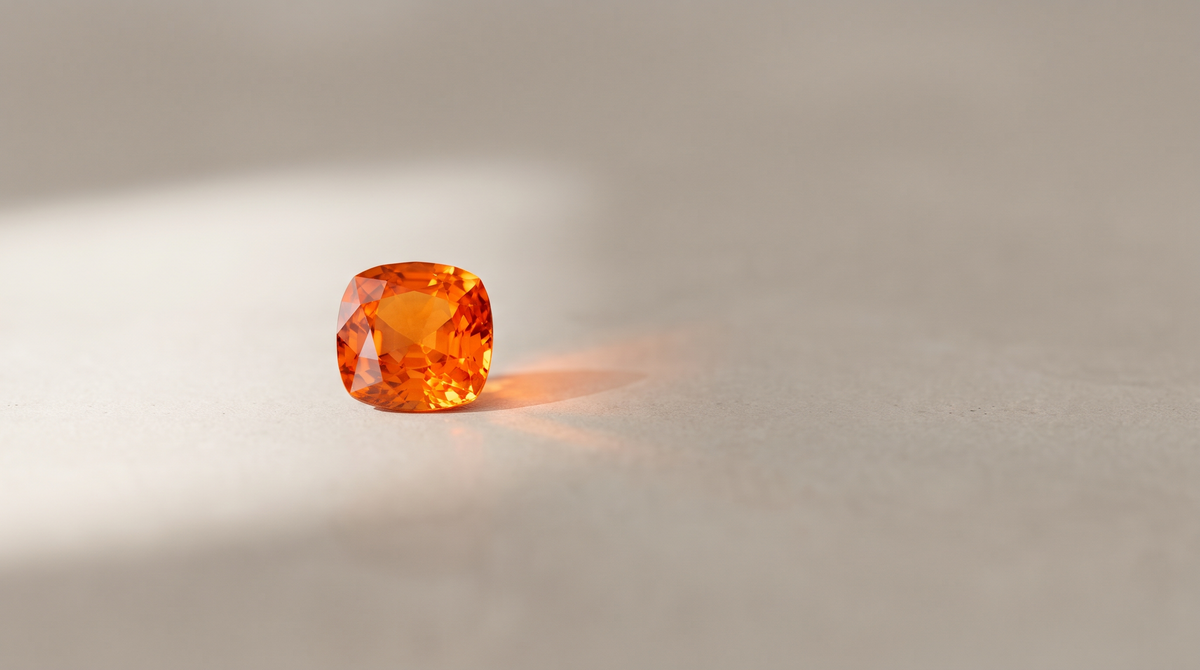
Spessartite garnet is the orange member of the garnet family, and its best stones are some of the most saturated orange gems in the trade. This guide explains what separates a "Mandarin" stone from an ordinary one, where the material comes from, what moves the price and what to check before you buy.
What spessartite is
Spessartite and spessartine are two names for the same mineral; GIA uses spessartine, while much of the trade says spessartite. It is a manganese aluminium garnet, and manganese is an essential part of its chemistry rather than a trace impurity. That manganese is what makes it orange. The name comes from the Spessart hills in Bavaria, where the mineral was first recorded in the nineteenth century.
Gem spessartite is rarely a pure end member. Gübelin describes Mandarin garnets as mixed garnets, mainly spessartine with some pyrope and almandine. Like all garnets it is singly refractive, so it shows no pleochroism, and a refractive index of roughly 1.79 to 1.80 gives a well-cut stone strong brilliance. With a hardness of 7 to 7.5 and no cleavage, it wears well in earrings, pendants and rings worn with reasonable care.
Mandarin and Fanta: what the names mean
"Mandarin garnet" is a trade name, not a separate mineral. It describes spessartite of a clean orange, free of the brown or red modifiers many stones show. Gübelin points out that because the term is commercial, its definition can vary slightly from seller to seller. "Fanta" is a further, informal descriptor for a bright soda-orange hue.
These names matter because colour drives price. GemGuide's August 2026 Gem Focus reports that the finest orange spessartites are the most expensive in the category and sometimes cost more than twice as much per carat as comparable stones in other hues. Neither term is a standardised grade, so judge the stone in front of you rather than the label attached to it.
Where spessartite comes from
Namibia
The modern market for orange spessartite began in 1991, with finds along the Kunene River in north-west Namibia, on the Angolan border. The material was clean and intensely orange, and was first sold as "Kunene spessartine" or "hollandine" before "Mandarin" took hold. According to the International Colored Gemstone Association, the deposit was exhausted after a short time.
Nigeria
Nigeria began supplying bright orange spessartite in the 1990s, and GemGuide credits it with some of the largest and finest stones on the market. Analyses cited by the International Gem Society show that Nigerian material can be close to pure spessartite, at around 95 per cent. Lang Antiques notes that output has declined since around 2001, though dealers still report new parcels.
Tanzania
Gem-quality spessartite was found at Loliondo in 2007, according to Lang Antiques. Analyses cited by the International Gem Society give Tanzanian material a pyrope component of about 18 per cent, so it is less pure than the Nigerian stones. Speaking to Rapaport in January 2026, the Bangkok dealer Gil Yuda named Nigeria and Tanzania as the two dominant sources today.
Other sources
Spessartite has also been found in Madagascar, Brazil, Sri Lanka, Myanmar and the United States, where the Little Three Mine in Ramona, California, had its main production in the 1970s. Much of today's mining is artisanal. Josh Saltzman of the cutting firm Nomad's told Rapaport that the high gold price has drawn artisanal miners away from gemstones, and that where piles of rough once arrived, "Now it's just one or two pieces."
What drives price
Colour
Colour is the main value factor. The closer a stone is to a pure, bright orange, the more it is worth; brown, red or dark tones lower the price. View any stone in daylight and under warm indoor light before deciding, since a single photograph rarely shows the full picture.
Size
Fine orange material becomes scarce quickly as weight goes up. GemGuide reports that supply of orange stones has fallen sharply, especially finished goods over 2 carats. Dealers interviewed by Rapaport say fine garnets above 5 carats are uncommon and that this rarity pushes prices higher, and the International Gem Society describes stones above 10 carats as extremely rare.
Brightness and cut
A high refractive index rewards a good cut. GIA advises buyers not to compromise on cut and notes that poorly cut garnets sell at a discount. Gil Yuda recommends a step-cut pavilion under a modified brilliant crown for the material, and says cushions and ovals are especially popular. In practice, tilt the stone: it should stay lively across the face, without a dark centre or a see-through window.
Clarity
Spessartite is usually more included than red garnets. GIA notes that spessartine often has inclusions visible to the eye, while almandine, pyrope and rhodolite typically do not, and the market is more forgiving as a result: dealers quoted by Rapaport say minor inclusions are often accepted in spessartite and can even add to its glow. Typical inclusions include curved fibres and small crystals such as quartz. What matters is whether they are visible face-up and whether any reach the surface where they could weaken the stone.
With spessartite, colour sets the price and the cut decides whether you actually see it.
Treatments
Spessartite is one of the few coloured gems where treatment is not a routine concern. The International Gem Society says Mandarin garnets normally receive no treatments or enhancements, Gübelin says they are not treated, and Lang Antiques lists spessartite as usually not treated. GIA's garnet buyer's guide likewise says garnets do not typically raise treatment concerns that affect durability.
"Usually" is not "never", and imitations exist. The International Gem Society reports no synthetic Mandarin garnet, but orange glass and man-made YAG (yttrium aluminium garnet) have both been used as simulants. An independent laboratory report confirms the species and that the stone is natural; for a significant purchase, ask whether the report comments on treatment. Our page on certification and treatments explains how to read one.
Buying checklist
- Colour first: look for a clean, bright orange and check it in daylight and warm indoor light.
- Treat "Mandarin" and "Fanta" as descriptions, not grades; compare stones with each other, not with their labels.
- Check brightness face-up: the whole stone should return light, with no dark or see-through centre.
- Expect some inclusions; decide what you are happy to see at normal viewing distance, and avoid any that reach the surface near a corner or point.
- Get weight, dimensions and stated origin in writing; origin is the seller's claim unless a laboratory supports it.
- For stones above about 2 carats, or any stone priced as top colour, ask for an independent laboratory report.
- Be wary of an orange "garnet" offered at an unusually low price per carat; it is worth testing for glass or YAG.
Browse our spessartine garnet collection, or the wider garnet collection for other species.
This article discusses prices and value in general terms, drawn from published trade sources. It is market information, not investment advice.