Sapphire origin explained: Kashmir, Burma, Sri Lanka, Madagascar and beyond
How Kashmir, Burma, Sri Lanka and Madagascar sapphires differ, how labs determine origin, and what 2025-2026 auction results show about the origin premium.
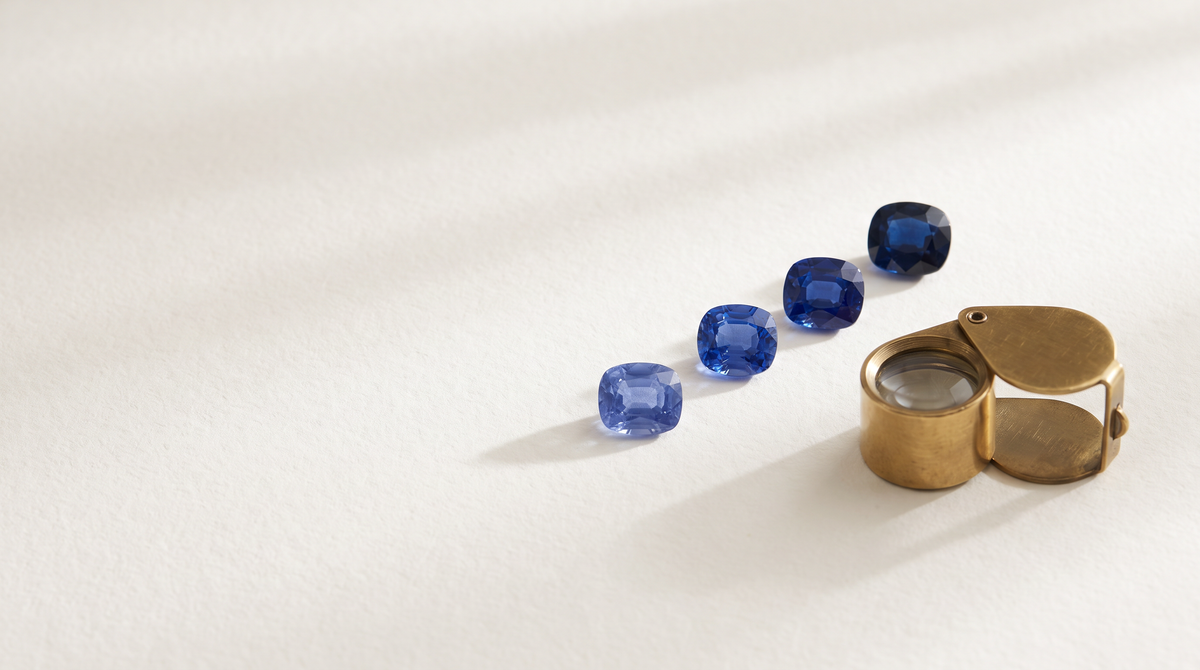
Two blue sapphires of similar size and colour can differ in price many times over, and the line on the laboratory report that often explains much of the gap is origin. This guide covers what Kashmir, Burma, Sri Lanka and Madagascar each mean, how laboratories reach an origin opinion, and what recent auctions show about the premium.
Why origin matters
Gemmologists divide blue sapphire sources into two broad families. Metamorphic deposits, including Kashmir, Myanmar (Burma), Sri Lanka and Madagascar, tend to produce stones with relatively low iron. Basalt-related deposits, such as Australia, Thailand, Cambodia, Nigeria and Ethiopia, produce iron-rich stones with a characteristic absorption pattern. Within each family, some localities have centuries of reputation behind them, and the market pays for that history as well as for the stone itself.
Origin is not a quality grade. A fine sapphire from Madagascar can outshine an ordinary one from Sri Lanka. But at the top of the market, a well-documented classic origin can move prices dramatically, as the auction results below show.
The classic sources
Kashmir
According to a 1983 study in GIA's Gems & Gemology, the Kashmir deposit was exposed by a landslip in 1881 in the Paddar area, on the southwest slopes of the Zanskar Range. The richest production came in the first few years, up to about 1887, and in 1907 a mining officer's survey confirmed the belief that the source was depleted. The stones are known for a soft, velvety look, which the same study links to colour zoning and fine layers of microscopic inclusions. Because the deposit was productive for so short a time, most Kashmir sapphires on the market today come from that brief early period.
Burma (Myanmar)
Sotheby's describes Burmese sapphires as generally darker than Kashmir stones, with mining severely limited today. They are rare, but more plentiful than Kashmir material. Under the microscope, twinning and arrowhead-shaped silk are among the features gemmologists associate with them.
Sri Lanka
Sotheby's describes Sri Lanka as home to the oldest sapphire mines in the world, according to historical accounts, and says Ratnapura has produced sapphires for more than 3,000 years. Sri Lankan blues range from light sky blue to saturated royal blue and are often lighter and livelier than stones from other sources. The island is also known for large stones. Sotheby's notes that most sapphires on the market are heat-treated and puts unheated Ceylon stones at only about 1% of sapphires in circulation.
Madagascar
Madagascar is the newest of the major sources and now one of the most important. The Ilakaka deposit was discovered in 1998 and became, in GIA's assessment, probably the world's largest sapphire producer in the years that followed. In October 2016 a rush of an estimated 45,000 miners hit Bemainty, near Ambatondrazaka. GIA reported that most of that blue rough was milky and would benefit from heating, though some fine, clean stones over 100 ct were reported.
Bemainty also showed why origin reports matter. In March 2017 SSEF warned the trade about "Kashmir-like" sapphires from the new deposit, after stones from Bemainty reached its laboratory already carrying reports that stated Kashmir origin.
How laboratories determine origin
A 2019 Gems & Gemology paper by Aaron Palke and colleagues explains GIA's method in some detail:
- Spectroscopy first. A UV-Vis-NIR absorption spectrum sorts a stone into the metamorphic or basalt-related family.
- Inclusions. Rutile silk, particle clouds, mineral crystals and colour banding are examined under the microscope and, where possible, identified by Raman spectroscopy.
- Trace elements. Laser ablation mass spectrometry (LA-ICP-MS) measures magnesium, titanium, vanadium, iron and gallium, which are compared with reference stones of known origin.
No single clue settles the question. The paper describes how Madagascar sapphires can overlap, sometimes heavily, with stones from every other metamorphic source. Madagascar stones can show Kashmir-like milky bands, Burmese-style twinning or Sri Lankan-style long silk. Heat treatment dissolves silk and can make origin very difficult to call. Where the evidence does not agree, GIA says a laboratory must report the origin as inconclusive.
When it flagged the Bemainty stones, SSEF said it could separate them from Kashmir sapphires by differences in clarity, growth zoning, colour zoning and zircon inclusions. Gübelin uses radiometric age determination to give scientific context to origin studies, and reports a reference collection of more than 28,000 gemstones.
An origin report is an expert opinion built from evidence, and it is only as strong as that evidence.
For a short guide to reading any laboratory report, see our article on GIA coloured gemstone reports.
What recent auctions show
Prices are as reported by the auction houses and trade press; the Cheffins figure is a hammer price before buyer's premium. Per-carat figures are our own rough calculation and include the value of any mount.
Kashmir
- Christie's Hong Kong, 25 November 2025: The Royal Blue, a necklace of 16 unheated Kashmir sapphires totalling 104.61 ct, sold for about US$16.2 million, a record for a Kashmir sapphire necklace at auction.
- Sotheby's Geneva, November 2025: a Van Cleef & Arpels ring with a 7.69 ct Kashmir sapphire made CHF 914,400 against a high estimate of CHF 650,000, or roughly CHF 119,000 per carat.
- Christie's Geneva, May 2026: a Chaumet ring with a 22.28 ct unheated Kashmir sapphire sold for more than US$3.5 million, above US$157,000 per carat. A Bulgari ring with a 9.82 ct unheated Kashmir sapphire made more than US$1.7 million, over double its high estimate.
- Sotheby's Geneva, Fine Jewelry sale, May 2026: an 8.40 ct sapphire ring with a Gübelin report stating Kashmir origin and no indications of heating was estimated at CHF 12,000 to 18,000. It sold for CHF 384,000.
Burma and Sri Lanka
- Cheffins, 20 November 2025: a ring with a 14.8 ct Burmese sapphire was hammered at £75,000, five times its lower estimate of £15,000, before buyer's premium.
- Christie's Hong Kong online, 5 December 2025: a ring with a 15.28 ct Sri Lankan sapphire sold for about US$261,000, roughly US$17,000 per carat. A 12.21 ct Sri Lankan sapphire reached HK$1.5 million, three times its high estimate.
The gap is plain: per carat, the Kashmir results run several times higher than the Sri Lankan ones. Treat the comparison with caution, though. The reports did not always state treatment, and colour, clarity, cut, size and the maker's name all affect price alongside origin.
For the Geneva sales in more detail, including the lots offered in November 2026, read our Geneva jewellery auctions report.
What this means for a buyer
- Ask for the report, not the story. Origin should come from an independent laboratory, ideally with the report number checked online.
- Read origin and treatment together. "Kashmir, no indications of heating" and "Sri Lanka, heated" describe very different stones in market terms.
- Expect disagreement at the margins. Madagascar's overlap with older sources means two laboratories can occasionally reach different conclusions, and "inconclusive" is an honest answer.
- Buy the stone first. Origin adds value to a beautiful sapphire; it does not make an ordinary one beautiful.
You can browse our blue sapphire collection, and our certification and treatments page explains how we describe origin and treatment.
This article summarises auction results and laboratory publications as reported by the sources below. Prices are as reported, and estimates are not guarantees. It is market information, not investment advice.